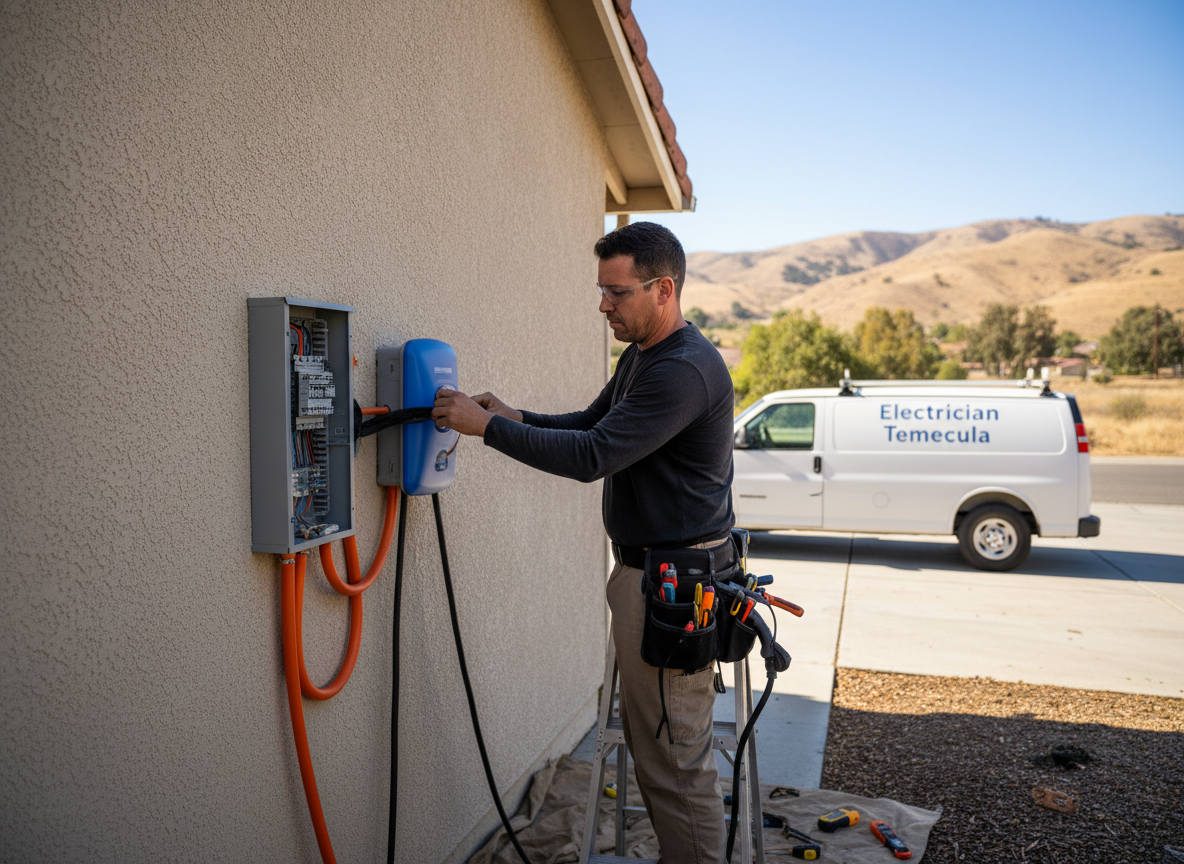
Electrician Temecula installs EV chargers throughout Temecula following the city's residential EV charger permit guidance. Installation starts with a load calculation, since a Level 2 charger draws a continuous 240 volt load, commonly requiring a 40 to 60 amp dedicated circuit depending on the charger and vehicle. That load has to fit within what the existing panel's busbar rating allows alongside everything else already on the panel, and in homes that also have solar or are considering it, the EV circuit adds another variable to the 120 percent rule calculation. Where the panel doesn't have room or capacity, the job becomes a panel upgrade conversation rather than a straightforward charger install, which is why an accurate load calculation up front avoids buying equipment that can't be installed as planned.
Temecula has load growth patterns that make this calculation matter more than it might elsewhere: many homes already run a pool pump, a second AC condenser for an addition, or a casita off the same 200 amp service that was adequate for the original house alone. Conduit routing is its own consideration, since most Temecula homes have stucco exterior walls and garages set some distance from the panel, meaning the circuit often runs through conduit (EMT or PVC depending on exposure) along or through the garage wall to reach the parking location. HOA architectural guidelines in most master planned communities also specify how charger equipment and conduit can look from the street, which affects routing decisions before installation starts.
The City of Temecula publishes its own residential EV charger permit guidance, and a permit is required for the circuit and charger installation, reviewed against the California Electrical Code. Inspection checks conductor sizing, breaker rating, GFCI protection where required by the charger's listing, and proper termination at both the panel and the charging unit. A common issue found during EV charger consultations is a homeowner who already bought a charger sized for their vehicle without checking whether the panel has the busbar capacity to add that breaker safely, which sometimes means the load calculation determines the charger needs to be a lower amperage model or the panel needs an upgrade first.
Technician insight
In Temecula, the thing that catches most people out with EV Charger Installation is the number of homes in Old Town and Harveston still running on 100-amp panels installed decades ago. Those panels already run close to capacity with summer AC loads, so adding a charger without an upgrade trips breakers during the first heat wave. We always check the actual bus rating and grounding before quoting the job.
Redhawk Home Charger Install
Homeowner in Redhawk requested a Level 2 charger but the 200-amp panel showed limited headroom once AC and pool equipment loads were calculated. We identified an available breaker space after confirming the bus rating and ran conduit along the side yard to the garage. The charger now operates without nuisance trips even on the hottest summer days.
EV Charger Installation Services We Offer
✓Level 2 Home Charger Installation
Dedicated 240 volt circuit and charger mounting for standard home EV charging.
✓Panel Capacity Assessment for EV Charging
Load calculation confirming whether the existing panel can support a charger circuit as-is.
✓Garage and Exterior Conduit Routing
Running EMT or PVC conduit from the panel to the charger location across stucco or garage interior walls.
✓Multi-Vehicle Charging Circuits
Wiring for households adding charging capacity for more than one EV.
✓EV Charger and Solar Coordination
Sizing EV charging circuits alongside existing or planned solar and battery systems under the 120 percent rule.
✓HOA-Compliant Charger Installation
Routing and mounting equipment to satisfy HOA architectural guidelines on visible exterior installations.
✓Charger Circuit Upgrades
Increasing an existing lower-amperage EV circuit to support a faster charger or a new vehicle's requirements.
✓Commercial and Multi-Family EV Charging
Charger installations for HOA common areas, multi-family properties, or small commercial fleets.
How it works
- 1
Load calculation
Against the existing panel and any planned solar, battery, or other major loads.
- 2
Charger location and conduit routing plan
Accounting for garage layout and HOA guidelines.
- 3
Permit and installation
Permit submission per the City of Temecula's residential EV charger guidance, then circuit installation.
- 4
Inspection and final connection
With the charger tested under load before handoff.
Pricing
EV charger installation cost depends on the distance from the panel to the charger location, whether conduit has to run through stucco, attic, or garage finished walls, and whether the load calculation shows the panel can accept the new circuit as-is or needs upgrade work first. A garage charger near the panel is a simpler job than one requiring a long conduit run to a detached garage or driveway location. We quote after seeing the route and the panel.